I wanted briefly educate you on when and why you would consider using a heavier photoresist material. I will also, touch on depth, blasting pressures, paint fill, photomask removal and offer you free samples for you to try.
The focus of this article will be mainly about the concrete paver brick. Though, there are many types of unpolished and irregular surfaces that I could mention, I will stick with the two that I seem to get asked about most often. They are the concrete paver brick and the traditional clay brick. These bricks are most commonly used in projects such as donor walls and walkways.
You should first know the difference between the two; I’ll begin with the traditional clay brick though there are different densities in clay brick, in comparison to concrete brick, the clay brick is made of sand and clay. I won’t go into the science of it all but; I will say that the clay brick does engrave much quicker than concrete in general because of its combination of matter. The cost of clay brick is a bit more expensive to purchase and can be personalized for any project.
Sandcarving several bricks can be labor intensive. Consider the time and labor it will take to move several heavy bricks, before bidding on and/or accepting a brick project.
Using SR3000 Photoresist Film as an Option
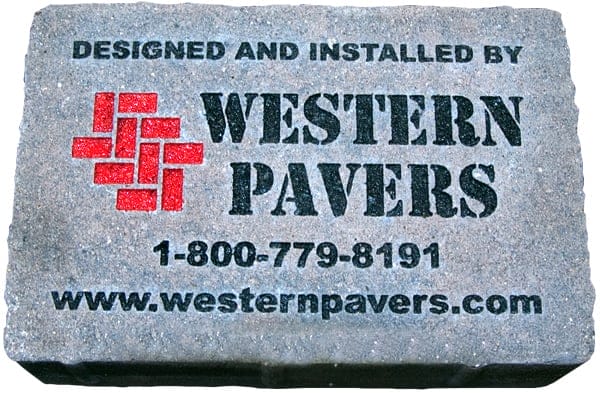
SR3000™ was used on this brick.
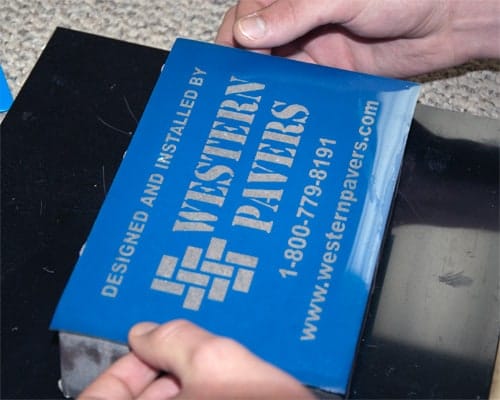
If your project is a traditional paver brick and requires a light to medium etch in depth and the option to paint fill, then I would recommend using SR3000 Self Stick film in the 5 mil. SR3000 has industry-leading durability that can not be found in a self stick film. You can trust it for its versatility with depth, fine details, and on flat or curved surfaces and most irregular surfaces. You will be thrilled with the results however, keep in mind when using SR3000 you will need to apply extra adhesive.
Concrete by nature is a hard and what we call extreme surface. Concrete bricks are made with an aggregate mixture and can contain large pebbles throughout. The quality of the mixture will vary and depend on the manufacturer. If you are bidding on a concrete brick job, I recommend you use builders’ grade concrete mix, which contains smaller pebbles in the mixture and is easier to carve while sandblasting.
As I continue, I’ll cover the material and sandblasting pressures.
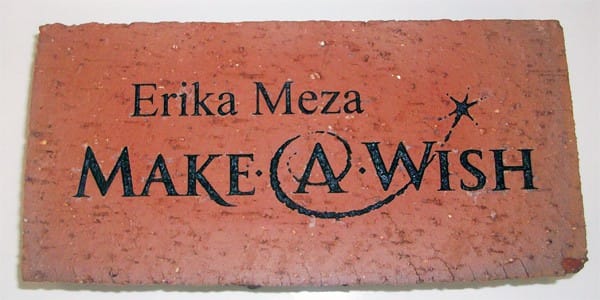
Blasting on concrete can be a challenge but with the right material and tools, you can knock your project right out! Here are some examples of a concrete brick sample project that were done by one of our customers Martin Laser.
SR2000™ 6mil was used to blast this brick project. Read more about what he had to say…
“I was very impressed with how the mask held up after hitting it so long to achieve the depth we wanted, still allowing the sharp detail of corners and edges in the text and design. What I notice about the Rayzist photomask that differed from other masks we’ve used from other manufacturers is that; it hugged and held onto the paver very well, not blowing out or coming off to cause error in the job.”
Using SR2000 Photoresist Film
If your need is for a deep carve and your artwork is bold with thick lines in nature and some moderate detail; I would recommend, the “Heavy Duty Hitter” SR2000 6mil, photoresist film for its ease of use and extreme durability.
The beauty of the SR2000 photoresist film is its durability to withstand high blasting pressures, its versatility and flexibility to apply it to any extreme or unpolished surface. The ease of use is also a plus and there’s also an extra option to paint fill your project all with the one stencil.
Try a sample of the material for yourself! Call 800-729-9478 and speak to one of our sales representatives today!
Blasting Abrasive and Pressures
The blasting pressures will vary depending on each project however, if its depth you are after and you are doing multiple pieces; I have provided a guide for starters.
You may want to blast a sample piece if you feel it’s necessary.
Changing your abrasive to a coarser grit will help facilitate the blasting process but may not be completely necessary. This depends on the nature of the projects solid condition. If the stone or concrete is more porous, then using a 150 grit aluminum oxide will do just fine. You can also use 150 grit silicon carbide as your blasting abrasive. When using a 150 grit abrasive the recommended blasting pressure is 40 – 45 psi.
If you have a multiple piece project and a much harder and larger surface to work with, I would recommend changing your abrasive to at least 120 – 100 grit this will speed up the engraving process. When using 100 grit abrasive the recommended blasting pressure is up to 60psi when using 6mil. (When using a thicker mil such as; SR2000 9Mil photoresist material 80+psi can be used)
Here is the difference between the two:
Aluminum oxide: a sand-like material coarse in nature and is used as a general blasting medium for engraving granite, marble and other stone products that require deep, heavy engraving. Brown aluminum is the ideal multipurpose and economic blasting material. Proper precautions need to be taken when exposed to finer particulate.
Silicon carbide: is preferred for flat lapping of materials such as glass, crystal, metals and ceramics. It is commonly used for blasting metals, because it leaves behind a polishing effect. SC cuts very quickly, faster than AO in pressure blast applications, because it has a sharper structure. It does not, however, recycle as well as AO. SC’s advantages include its reflective properties, polishing ability of metals, and speed of etch on glass. Proper precautions need to be taken when exposed to finer particulate.
Another thing to keep in mind when using a coarser abrasive is that the coarser the grit, the more apparent a texture will be and in this case, the texture will not make a difference because that is the nature concrete. Regardless of which abrasive you choose to use, either of the two will work, it all depends on your personal preference. Most importantly, they will both provide you the same result in the end.
Note: When quoting a project for a large production run, consider Rayzist Photomask to produce you stencils for you.
Paint Fill
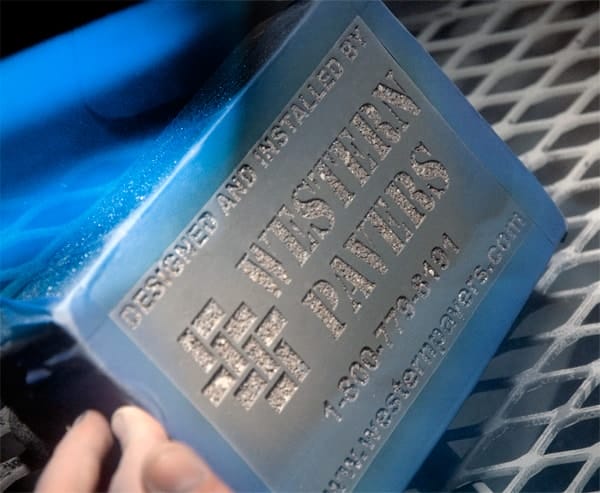
Part of the versatility of SR2000 photoresist film is that you are able to paint fill with the same stencil you have been sandblasting with since the beginning of this process. There is no need to remove and re-apply a new stencil.
Paint fill is easy and takes little time to do. If you are going to paint fill, we recommend using a Lithichrome paint. Lithichrome paint weathers well in various climates and is a durable paint for outdoor use. Not recommended for surfaces other than stone.
With your airline hose, simply blow out the excess dust from the engraved image area and spray your paint. Allow the paint to dry and then remove your stencil. The results are rewarding.
If you have never used SR2000™ photoresist material and would like to try a free 6 mil sample for yourself call (800) 729-9478 and speak to one of our sales associates today.
This mode enables people with epilepsy to use the website safely by eliminating the risk of seizures that result from flashing or blinking animations and risky color combinations.
Visually Impaired Mode
Improves website's visuals
This mode adjusts the website for the convenience of users with visual impairments such as Degrading Eyesight, Tunnel Vision, Cataract, Glaucoma, and others.
Cognitive Disability Mode
Helps to focus on specific content
This mode provides different assistive options to help users with cognitive impairments such as Dyslexia, Autism, CVA, and others, to focus on the essential elements of the website more easily.
ADHD Friendly Mode
Reduces distractions and improve focus
This mode helps users with ADHD and Neurodevelopmental disorders to read, browse, and focus on the main website elements more easily while significantly reducing distractions.
Blindness Mode
Allows using the site with your screen-reader
This mode configures the website to be compatible with screen-readers such as JAWS, NVDA, VoiceOver, and TalkBack. A screen-reader is software for blind users that is installed on a computer and smartphone, and websites must be compatible with it.
Online Dictionary
Readable Experience
Content Scaling
Default
Text Magnifier
Readable Font
Dyslexia Friendly
Highlight Titles
Highlight Links
Font Sizing
Default
Line Height
Default
Letter Spacing
Default
Left Aligned
Center Aligned
Right Aligned
Visually Pleasing Experience
Dark Contrast
Light Contrast
Monochrome
High Contrast
High Saturation
Low Saturation
Adjust Text Colors
Adjust Title Colors
Adjust Background Colors
Easy Orientation
Mute Sounds
Hide Images
Hide Emoji
Reading Guide
Stop Animations
Reading Mask
Highlight Hover
Highlight Focus
Big Dark Cursor
Big Light Cursor
Cognitive Reading
Virtual Keyboard
Navigation Keys
Voice Navigation
Accessibility Statement
www.rayzist.com
August 11, 2026
Compliance status
We firmly believe that the internet should be available and accessible to anyone, and are committed to providing a website that is accessible to the widest possible audience,
regardless of circumstance and ability.
To fulfill this, we aim to adhere as strictly as possible to the World Wide Web Consortium’s (W3C) Web Content Accessibility Guidelines 2.1 (WCAG 2.1) at the AA level.
These guidelines explain how to make web content accessible to people with a wide array of disabilities. Complying with those guidelines helps us ensure that the website is accessible
to all people: blind people, people with motor impairments, visual impairment, cognitive disabilities, and more.
This website utilizes various technologies that are meant to make it as accessible as possible at all times. We utilize an accessibility interface that allows persons with specific
disabilities to adjust the website’s UI (user interface) and design it to their personal needs.
Additionally, the website utilizes an AI-based application that runs in the background and optimizes its accessibility level constantly. This application remediates the website’s HTML,
adapts Its functionality and behavior for screen-readers used by the blind users, and for keyboard functions used by individuals with motor impairments.
If you’ve found a malfunction or have ideas for improvement, we’ll be happy to hear from you. You can reach out to the website’s operators by using the following email
Screen-reader and keyboard navigation
Our website implements the ARIA attributes (Accessible Rich Internet Applications) technique, alongside various different behavioral changes, to ensure blind users visiting with
screen-readers are able to read, comprehend, and enjoy the website’s functions. As soon as a user with a screen-reader enters your site, they immediately receive
a prompt to enter the Screen-Reader Profile so they can browse and operate your site effectively. Here’s how our website covers some of the most important screen-reader requirements,
alongside console screenshots of code examples:
Screen-reader optimization: we run a background process that learns the website’s components from top to bottom, to ensure ongoing compliance even when updating the website.
In this process, we provide screen-readers with meaningful data using the ARIA set of attributes. For example, we provide accurate form labels;
descriptions for actionable icons (social media icons, search icons, cart icons, etc.); validation guidance for form inputs; element roles such as buttons, menus, modal dialogues (popups),
and others. Additionally, the background process scans all the website’s images and provides an accurate and meaningful image-object-recognition-based description as an ALT (alternate text) tag
for images that are not described. It will also extract texts that are embedded within the image, using an OCR (optical character recognition) technology.
To turn on screen-reader adjustments at any time, users need only to press the Alt+1 keyboard combination. Screen-reader users also get automatic announcements to turn the Screen-reader mode on
as soon as they enter the website.
These adjustments are compatible with all popular screen readers, including JAWS and NVDA.
Keyboard navigation optimization: The background process also adjusts the website’s HTML, and adds various behaviors using JavaScript code to make the website operable by the keyboard. This includes the ability to navigate the website using the Tab and Shift+Tab keys, operate dropdowns with the arrow keys, close them with Esc, trigger buttons and links using the Enter key, navigate between radio and checkbox elements using the arrow keys, and fill them in with the Spacebar or Enter key.Additionally, keyboard users will find quick-navigation and content-skip menus, available at any time by clicking Alt+1, or as the first elements of the site while navigating with the keyboard. The background process also handles triggered popups by moving the keyboard focus towards them as soon as they appear, and not allow the focus drift outside it.
Users can also use shortcuts such as “M” (menus), “H” (headings), “F” (forms), “B” (buttons), and “G” (graphics) to jump to specific elements.
Disability profiles supported in our website
Epilepsy Safe Mode: this profile enables people with epilepsy to use the website safely by eliminating the risk of seizures that result from flashing or blinking animations and risky color combinations.
Visually Impaired Mode: this mode adjusts the website for the convenience of users with visual impairments such as Degrading Eyesight, Tunnel Vision, Cataract, Glaucoma, and others.
Cognitive Disability Mode: this mode provides different assistive options to help users with cognitive impairments such as Dyslexia, Autism, CVA, and others, to focus on the essential elements of the website more easily.
ADHD Friendly Mode: this mode helps users with ADHD and Neurodevelopmental disorders to read, browse, and focus on the main website elements more easily while significantly reducing distractions.
Blindness Mode: this mode configures the website to be compatible with screen-readers such as JAWS, NVDA, VoiceOver, and TalkBack. A screen-reader is software for blind users that is installed on a computer and smartphone, and websites must be compatible with it.
Keyboard Navigation Profile (Motor-Impaired): this profile enables motor-impaired persons to operate the website using the keyboard Tab, Shift+Tab, and the Enter keys. Users can also use shortcuts such as “M” (menus), “H” (headings), “F” (forms), “B” (buttons), and “G” (graphics) to jump to specific elements.
Additional UI, design, and readability adjustments
Font adjustments – users, can increase and decrease its size, change its family (type), adjust the spacing, alignment, line height, and more.
Color adjustments – users can select various color contrast profiles such as light, dark, inverted, and monochrome. Additionally, users can swap color schemes of titles, texts, and backgrounds, with over seven different coloring options.
Animations – person with epilepsy can stop all running animations with the click of a button. Animations controlled by the interface include videos, GIFs, and CSS flashing transitions.
Content highlighting – users can choose to emphasize important elements such as links and titles. They can also choose to highlight focused or hovered elements only.
Audio muting – users with hearing devices may experience headaches or other issues due to automatic audio playing. This option lets users mute the entire website instantly.
Cognitive disorders – we utilize a search engine that is linked to Wikipedia and Wiktionary, allowing people with cognitive disorders to decipher meanings of phrases, initials, slang, and others.
Additional functions – we provide users the option to change cursor color and size, use a printing mode, enable a virtual keyboard, and many other functions.
Browser and assistive technology compatibility
We aim to support the widest array of browsers and assistive technologies as possible, so our users can choose the best fitting tools for them, with as few limitations as possible. Therefore, we have worked very hard to be able to support all major systems that comprise over 95% of the user market share including Google Chrome, Mozilla Firefox, Apple Safari, Opera and Microsoft Edge, JAWS and NVDA (screen readers).
Notes, comments, and feedback
Despite our very best efforts to allow anybody to adjust the website to their needs. There may still be pages or sections that are not fully accessible, are in the process of becoming accessible, or are lacking an adequate technological solution to make them accessible. Still, we are continually improving our accessibility, adding, updating and improving its options and features, and developing and adopting new technologies. All this is meant to reach the optimal level of accessibility, following technological advancements. For any assistance, please reach out to