No products in the cart.

Back to Blog
Table Of Contents
PAIR PHOTORESIST FILM WITH A VARIETY OF SUBSTRATES FOR ENDLESS POSSIBILITIES
What makes sandcarving so unique? There are many engraving methods that may seem simpler, but sandcarving has many benefits—especially when using a photoresist film. There is no end to what you can produce when sandcarving with photoresist films. Unlike other processes, sandcarving also allows for a large variety of substrates, including glass and crystal, metals, wood, and stone. With any of these substrates, the secret to success is photoresist film. Since its creation by Rayzist in the early 1980s, photoresist has improved tremendously over the past 35 years. Today, the film is easy to produce, user friendly, and a major timesaver in the sandcarving process. Many types are available, in many thicknesses, enabling you to get the perfect film for your project. Photoresist films can be easily applied to curved surfaces—enabling you to sandcarve and paint fill. They release easily from the surface for fast cleanup.
Glass and Crystal
Let’s start with the basics of etching crystal and glass. Sandcarving enables you to create a unique relief that you can run your fingers over and feel. This relief gives sandcarving its high perceived valve. The operator of the sandcarving system controls of the depth of the carving, from a moderate to a deep etch. During the sandcarving process, the operator passes the blast nozzle over the stencil, carving into the surface with each pass to create depth. You can easily etch odd shapes or large objects with no special tools or attachments. The clarity of optic crystal results in beautiful sandcarving because the crystal appears to magnify the etching. Optic crystal can be very profitable because it is perfect for corporate awards or high-end gifts. Glass awards and spirits bottles are perfect for sandcarving because you can achieve relief into the surface, enabling you to later color fill. The greatest benefit of sandcarving is that it enables you to obtain depth in the substrate. Your customers will appreciate the etched look giving the item its high perceived value. Sandcarving is one of the best methods for engraving on crystal and glass, but don’t just stop at glass—there are many more materials that look great sandcarved!
[IMAGES HERE]
Metal
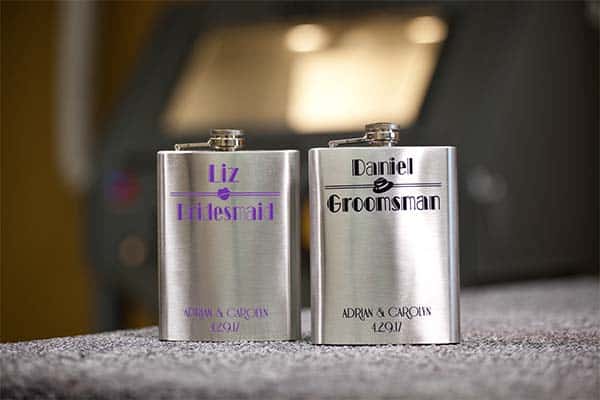
Follow the same process to sandcarve on metal, and you can even paint fill the surface. For example, take the popular Yeti tumblers. Our customers were engraving them, but this process could be time consuming with large quantities and short deadlines. Instead, several of our customers started sandcarving the Yeti tumblers to save time. They applied the stencils and sandcarved. The process is quick because sandcarving allows you to rapidly etch the surface in seconds—and when sandcarving metal, only the surface is only removed, meaning no depth is achieved. We suggest using a 3-mil photoresist film. It works perfectly for etching any type of metal, and applies easily to the metal surface.
We suggest using silicon carbide in a 120–220 grit range for sandcarving metal because it results in a bright finish, which looks great. Leave the etched metal as is or paintfill it with one or more colors. Leave the photomask on and apply the paint to the etched area. The photoresist stencil becomes your painting stencil, saving you time and money.
Wood
Another material that looks great sandcarved is wood. Unlike the laser, sandcarving systems remove the surface of the wood, revealing the natural grain and texture. Paint filling the etched area with one or or more colors provides contrast that completely brings out the design. Photoresist films are durable enough to handle sandcarving on hard surfaces and provide detail that stands out in the wood.
We recommended using an extremely sturdy film, such as SR2000™ 5- or 6-mil original photoresist film, and that you apply adhesive to the film for a high tack. If you are using a self-stick photoresist film, additional adhesive can be applied, providing a high-tack bond to better adhere to the wood surface. Some woods are soft and etch quickly, although hard woods will take longer to etch; either way, sandcarving is definitely a great method for etching wood surfaces.
Stone
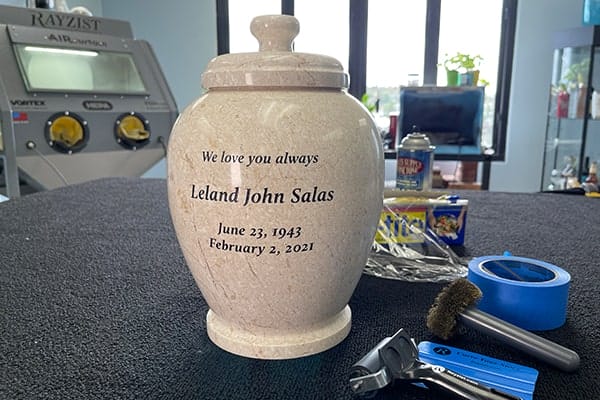
Natural stone is another sandcarving substrate that offers endless opportunities. Options include personalized river rocks, pet memorials, donor recognition projects, monument-stone engraving, and Corian, granite, and tile engraving for home décor. We recommend using 5-mil, 6-mil, or monument-grade film with added adhesive to provide a high bond to the surface. Again, you have the option for a surface etch or a deep etch on any of these materials, and paint fill application provides contrast.
Share